
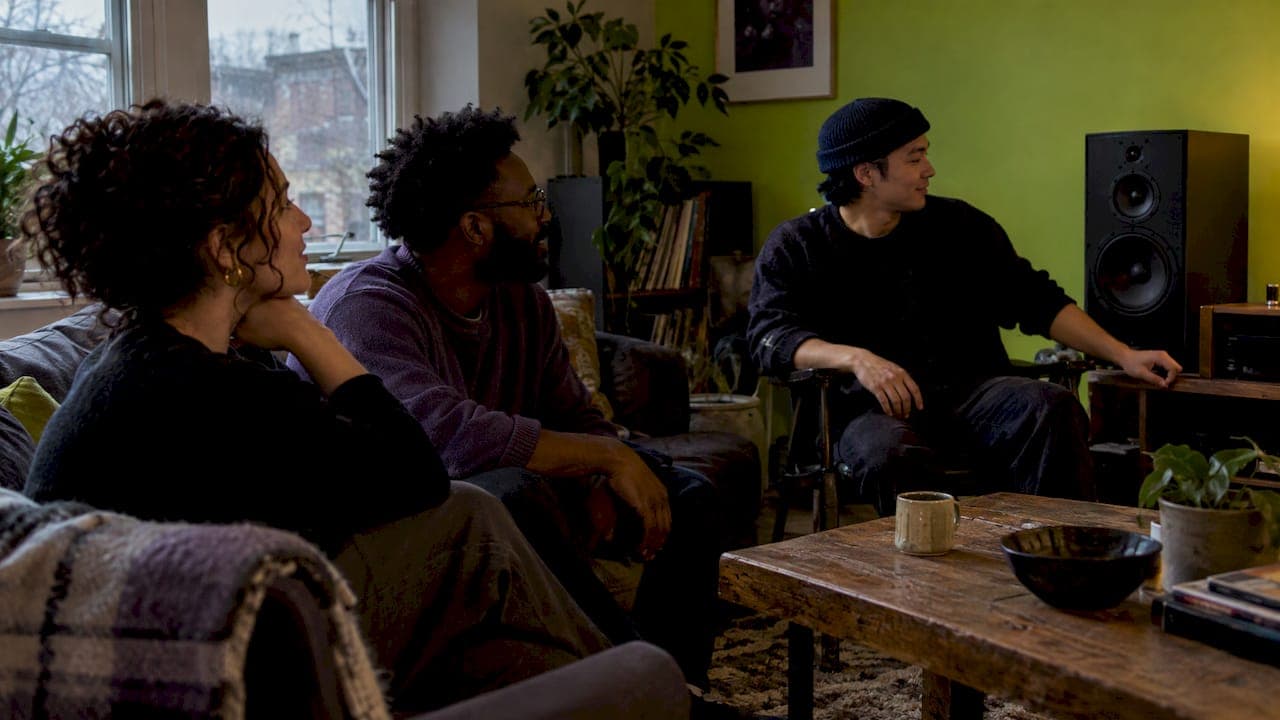
A music listening room is a space, physical or virtual, built so people give music their full attention, usually together. In person, that means a quiet room with good speakers. Online, it means a shared session where everyone hears the same song at the same moment and can add to the queue. This guide covers both, shows you how to create and host one, and explains what to check before you invite anyone.
TL;DR
- A listening room puts the music first: in person it is a quiet, well-set-up space, online it is a synced session where friends hear the same track at once.
- To create a group room online, start playback, open the sharing option, and send guests a link or QR code. You decide whether guests can change what plays.
- Keep groups small and give everyone a turn. Sharing the story behind a song matters more than judging it.
- Private rooms suit full-album, phone-away listening. Group rooms suit trading songs and finding new favorites.
- Sndbox is built for synced playback, queue trading and discovery with friends, and lets artists upload tracks directly to listeners.
Table of Contents
- What a music listening room actually is
- Why people are moving to shared listening
- How friends listen together in a group room
- How to create a group listening room, step by step
- Create a room on Sndbox
- Private listening rooms: one album, no distractions
- Setting up an in-person listening space
- What to check before you invite people
- How artists use listening rooms
- Where in-person events fit
- Our perspective
- FAQ
- Sources
What a music listening room actually is
The phrase covers more than one thing, which is why search results for it jump between hi-fi lounges and apps.
The original idea is acoustic. Listening rooms are spaces designed for high-quality sound, described as evolved versions of the listening booths in old music stores. They cut outside noise and use low light and comfortable seating to encourage focused listening. Bang & Olufsen's guide makes the same point from the equipment side: a dedicated listening room is designed to maximize sound quality, so you hear the nuances in a recording and deep bass with fewer distractions than in a multipurpose room.
The definition has also widened. Elle Decor notes that the term now reaches beyond strictly audiophile circles to any space meant for focused, relaxed listening. And the room does not have to be a room. A 2026 report on shared music describes listening as increasingly a shared cultural experience, with fans gathering in person or online, and notes that virtual listening parties let people share playlists in real time.
So when you hear "listening room," it helps to ask which of three things someone means:
| Type | Where it happens | Best for | Typical size |
|---|---|---|---|
| Private listening room | Your home, or a quiet corner you set up | Hearing a full album with no interruptions | One person or a pair |
| Group music room | An app or online session | Trading songs, discovering new music, staying connected across distance | A few friends to a larger circle |
| Listening bar or venue | A public space with a hi-fi system | A night out built around sound | Open to the public |
The rest of this article focuses on the middle row and on setting up your own private room, since that is what most people searching for "create a listening room" want to do.
Why people are moving to shared listening
Streaming made music effortless and also made it solitary. You put in earbuds, pick a playlist and never find out whether your friend would love the song you're hearing. Shared rooms fix that gap.
David C. Snyder of the Audiophile Foundation wrote that shared sessions turn a solitary hobby into a communal one, exposing participants to new music and new perspectives. That holds whether the gathering is a hi-fi system in a living room or a synced session between three cities.
There is also a difference between listening alongside someone and listening with them. In a synced room, the chorus lands for everyone at the same second. That is the whole appeal: shared reactions, shared surprise, and a reason to talk about the song afterward.
How friends listen together in a group room
Group rooms follow a few common patterns. Pick the one that matches your crowd.
The synced session
One person starts playback and everyone else hears the same thing at the same moment. Reactions happen live, in chat or on a call. It is the closest online equivalent to sitting on the same couch.
The queue swap
Everyone adds songs and the queue becomes a conversation. You learn a lot about friends from what they choose to play after yours. Trading queues is also the quickest way out of a recommendation rut, because the suggestions come from people whose taste you already trust.
The music sharing night
This is the in-person version of the queue swap. A guide from KF.Social describes sharing nights as small groups, typically four to eight people, taking turns playing songs, explaining why they chose each one, and listening without background chatter or phones. Its advice is to aim for context rather than critique: the personal story behind a pick is more valuable than a review of it.
That tip transfers neatly online. If your group chat turns every song into a debate, try the same rule. Say why you picked it, then let the music play.
The fan listening party
Fan communities often run listening parties where everyone presses play together and reacts in a live chat or voice room. A guide to fan community listening parties notes that larger groups need moderators to keep the conversation focused across channels. If your room grows beyond close friends, assign someone to keep the thread on the music.
How to create a group listening room, step by step
The mechanics are similar across apps that offer group sessions. As an example, TechRepublic's October 2026 guide to a major streaming app's group session feature walks through the flow: play a song or playlist, open the device connection menu, start a group session, then invite people with a QR code or link. Guests can add songs, explore group recommendations and, unless you restrict it, control playback.
You can adapt that into a general routine:
- Decide the purpose. Is this a discovery night, an album premiere for friends, or background music for a get-together? The purpose sets the rules.
- Start with a strong first track. Something familiar to everyone gets people settled. Save the weird stuff for round two.
- Open the shared session in whichever app you use and generate the invite link or QR code.
- Send the invite before the start time, so nobody is fiddling with a login while the first song plays.
- Set permissions. Choose whether guests can only add songs or can also skip and pause. In the app above, turning off the option that lets others change what's playing keeps playback with the host while guests still contribute tracks.
- Set a turn order if the group is more than four or five. One song each, then loop.
- Leave room for talk. Add a short pause between songs or a call open on the side.
Rules that keep a room fun
- One person at a time controls skipping. Skip wars ruin a session faster than any bad song.
- No shame for any pick. If someone adds a guilty pleasure, that is the point of the exercise.
- Keep sessions to a length people can sustain. Ninety minutes is plenty for a first round.
Create a room on Sndbox
Sndbox is a music platform built around exactly this idea: friends enjoying music together in real time. You can sync playback so everyone hears the same moment, trade song queues, and discover new favorites as a group. It also lets artists upload tracks directly to listeners, so a room can be where new music first lands.
If you want to try a shared session with your own friends, head to Sndbox and set up your first one.

We designed Sndbox for people who want music to be something they do together rather than alone, and who want artists in that conversation too.
Private listening rooms: one album, no distractions
A private listening room is the opposite of a party. The point is focus.
Designer Devon Turnbull, speaking to The Hollywood Reporter in 2026, said listening at home lets a person dedicate their attention, unlike communal spaces where outside inputs intrude. Bang & Olufsen's view is similar: separating playback from everyday activity reduces distractions and exposes more detail.
You do not need a luxury system to borrow the habit. A private session at home can be as simple as this:
- Pick one album and play it start to finish.
- Put phones in another room and pause conversation while it plays.
- Afterward, write down what stood out, or talk it over if others are with you.
That last step matters. Listening is a form of participation in itself, and discussion works best after the record ends rather than over it.
Private room versus group room
| Private listening room | Group music room | |
|---|---|---|
| Goal | Deep attention to one work | Shared discovery and connection |
| Who picks | One person, or an agreed album | Everyone takes turns |
| Talking | After the music | During and between songs |
| Best setup | Quiet space, good speakers or headphones | Synced app session plus chat or a call |
| Great for | Album premieres, new releases you have waited for | Finding new favorites, staying close to far-away friends |
Many groups use both. Start with a private-style listen of one new album together in sync, with chat muted, then open the floor to a queue swap.
Setting up an in-person listening space
If you want to host friends in a room at home, a few decisions make the biggest difference.
Mind the sweet spot. In speaker-based listening, the best position is typically tuned for one listener. Snyder reports that his sessions usually involved two or three people because of floor space and that single sweet spot. If you have a serious stereo setup, keep the group small or rotate seats between tracks. If you are using a portable speaker or headphones with a synced session, the constraint disappears.
Control the room. Dim the lights, silence notifications and put the seating where people can relax. Elle Decor's description of listening rooms stresses comfort and low lighting alongside sound.
Structure the session. Snyder's format is a good template: begin with a short explanation of the equipment and room, play a few reference tracks, then let guests queue recordings they know well, with discussion, recommendations and refreshments along the way (all per his account of the sessions).
Add a visual layer if you like. For music sharing nights, hosts can show album art or music videos on a screen to add another layer of engagement.
Test before guests arrive. Check your speaker and connection ahead of time, and have a backup plan if audio drops.

What to check before you invite people
A little preparation avoids the awkward moments.
Playback control
Decide who can skip, pause and reorder. For a friends' night, shared control is part of the fun. For a premiere of someone's album, keep control with the host so nothing interrupts it. Most shared-session tools let you restrict guests to adding songs only.
Who gets the link
An invite link or QR code works like a key. Send it in a private chat rather than posting it publicly, and start a new session if the link ends up somewhere you did not intend.
Audio and connection
Everyone in a synced room should be on a stable connection. If one person lags, their reaction to the drop comes three seconds late and the moment is gone. Ask guests to use headphones or a decent speaker, and keep a backup plan ready in case someone's audio fails.
Cost and accounts
Some features across music tools sit behind accounts or subscriptions. Check what your guests will need to join before you send the invite, so nobody is blocked at the door. For Sndbox, see the welcome page for the current details.
How artists use listening rooms
For artists, a listening room is a direct line to the people who care most. Orphiq's guide to planning listening parties notes that artists can host live events, debut unreleased tracks, and engage fans through commentary or Q&A, and it suggests tools ranging from community chat platforms for interaction to live video for broader reach.
The pattern is not new to the internet era. The Hindu reported in 2020 on online listening rooms in Indian indie music, where musicians debuted unreleased tracks and received real-time feedback and emotive reactions through chat. The same coverage describes them as hubs that kept artists and fans connected when in-person gatherings were limited.
If you are an artist thinking about hosting one, a simple run of show works:
- Introduce the project in two minutes. Who, what, why now.
- Play the tracks in order, uninterrupted.
- Share a short story or note about each song, either live or in chat.
- Open a Q&A once the music ends.
- Invite listeners to bring friends to the next one.
On Sndbox, artists can upload tracks directly to listeners, which keeps the path from release to room short.
Where in-person events fit
Online rooms do not replace the real thing, and they do not need to. Listening events can take place in record stores, small venues or art galleries, where record stores bring built-in foot traffic and virtual formats are easier for more people to join. Successful in-person events often add physical touches such as merch, photo spots and structured artist commentary to give the evening a sense of occasion.
In big US cities, listening bars with hi-fi systems have become a popular night out. If you live near one, it is a good way to hear what a serious sound system can do. Then take what you liked home and build a smaller version of it.
Our perspective
We built Sndbox on a simple belief: music is better when someone else is listening with you.
Most streaming is designed for one person and one pair of earbuds. That is convenient, but it leaves out the part of music many of us love most, which is the moment a friend hears a song for the first time and reacts. A listening room should bring that moment back, whether you are in the same city or not.
That is why our focus is group engagement. Synced playback means the same beat lands for everyone at once. Trading queues means discovery comes from people you trust, not from an anonymous feed. And because artists can upload tracks directly to listeners, a room can be where a new song meets its first audience, with the person who made it close at hand.
We think the best rooms are small, intentional and generous. Take turns, tell the story behind your pick, and let the music do the rest. That is the experience Sndbox is designed to make easy.
the author
FAQ
What is a music listening room?
It is a space, in person or online, set up so people give music their full attention. In person, that usually means good sound and a calm setting. Online, it means a shared session where friends hear the same track at the same moment and can add songs together.
How do I create a private listening room?
For a physical room, choose a quiet space, dim the lights, silence notifications and use good speakers or headphones. For an online room, start a shared session, send the invite link or QR code only to the people you want, and limit guests to adding songs if you want to control playback. Keep the group small so everyone gets a turn.
How many people should be in a group music room?
For in-person sharing nights, four to eight people is a common range. With a speaker setup that has a single best seat, two or three works better. Online, you can go larger, but assign a moderator once the chat gets busy.
Can artists host their own listening rooms?
Yes. Artists can debut tracks, answer questions and react with fans in real time. On Sndbox, artists can upload tracks directly to listeners, which suits this kind of session.
What do I need for group audio listening online?
A stable connection, headphones or a decent speaker, and an app that supports shared sessions. Share the invite ahead of time and keep a backup plan in case someone's audio drops.
Sources
- Why Listening Rooms Are Taking Over, Elle Decor
- Music Listening Room Guide, Bang & Olufsen
- From earbuds to listening rooms, shared music experiences, Korea JoongAng Daily
- Hollywood's Latest Must-Have Luxury? Listening Rooms, The Hollywood Reporter
- Building Community Through Shared Listening Sessions, Audiophile Foundation
- How to Host a Music Sharing Night With Friends, KF.Social
- Listening Party Ideas for Music Fan Communities, The Yard
- Hosting a Halloween or Holiday Gathering? How to use group sessions, TechRepublic
- Listening Party: How to Plan One, Online or In Person, Orphiq
- Online listening rooms are the new hub of Indian indie music, The Hindu